TACT: Tracking Asking Cost over Time for Personalized Clarification
Robots facing ambiguous instructions must decide whether to ask or act, and prior work treats the human cost of asking as a constant. TACT learns this cost as a function of user state (emotion, time, habits) from implicit interaction feedback, never querying users about their preferences, and distills it into a DPO clarification policy with a lightweight head over a frozen language model. Evaluated on a ground-truth-controlled benchmark and ten simulated users.
Jan 2026 to present, first author. Manuscript in preparation. Code
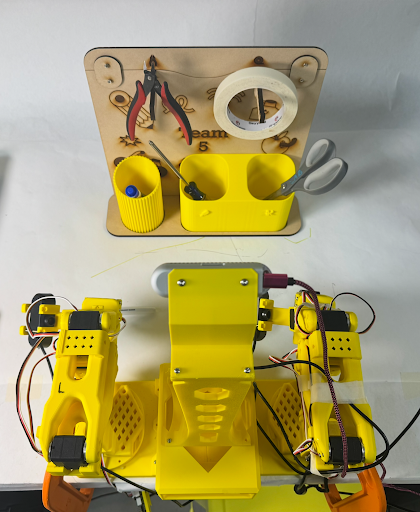
MPAIL2 Real-World Deployment on SO-101
Built the hardware wrapper and multi-stream observation alignment pipeline for training an IRL-based world-model algorithm on a real arm.
Mar to Aug 2026, UW Robot Learning Lab. My contribution: the real-arm deployment. Based on work: Paper. Code
AV-Phys Bench
AV-Phys Bench evaluates whether joint audio-video generation models understand real-world physics, rather than just producing plausible-looking sounds and frames. It tests Steady State, Event Transition, and Environment Transition scenes on five dimensions of semantic and physical commonsense.
Mar to May 2026, co-author. My contribution: benchmark design, rubric refinement for inter-annotator consistency, data collection and annotation verification. Paper
Algorithm Structure for Real-time General Game Playing Agents
General Game Playing studies AI agents that play unfamiliar games by reading only the rules at runtime, with no human intervention. Prior work has focused on turn-based games using generic heuristics or Monte Carlo/UCT search, but real-time games now dominate the market. This paper evaluates whether existing GGP algorithms can be adapted to real-time play and proposes a dual-server (strategy + acting) architecture to close the gap.
2022, independent research. My contribution: Sole author. Conducted the literature review and proposed the dual-server architecture, improving breadth and efficiency to better mimic human performance. Paper
WM-Verdict: Benchmarking the Reliability of World-Model Verdicts about Policies
A benchmark testing whether world models correctly predict policy success, pairing imagined rollouts with simulator ground truth from identical start states. I lead the experiment design and built the shared evaluation infrastructure. Aggregate estimates track ground truth, while per-start verdicts are much less reliable.
Sep 2026 to present, Research Assistant, UW. Advisor: Prof. Luyao Niu.
SAFEWORLD
A safety verification framework built on a frozen world model, reasoning over RSSM latent transitions and integrating DreamerV3 and TD-MPC2 toward sim-to-real deployment from Isaac Lab to the SO-101 arm.
Mar 2026 to present, collaborator. Ongoing.
Long-tail Bias Mitigation in HOI Detection
Undergraduate thesis. A QPIC-based framework with affordance-transfer-inspired enhancement and teacher-guided pseudo-labeling for Human-Object Interaction detection. It improves overall mAP by 1.6% and tail-class accuracy by 5.1% to 6.3% on V-COCO.
Dec 2024 to May 2025, Tongji University.